


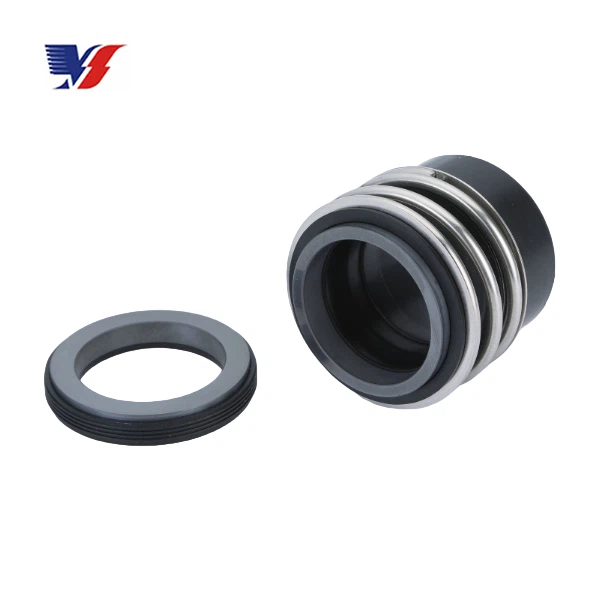
Rubber Bellow Mechanical Seal
What Is Rubber Bellow Mechanical Seal?
Rubber bellow mechanical seal is sealing devices that use a flexible rubber bellow to provide a sealing force on a stationary sealing element. This rubber bellow mechanical seal is commonly used in pumps, mixers, and other types of rotating equipment to prevent leaks and maintain the integrity of the system.
Flexibility
One of the main benefits of rubber bellow mechanical seal is their ability to handle a wide range of fluids, including water, oils, and chemicals. The flexibility of the rubber bellows can compensate for shaft deflection and vibration, ensuring a tight seal even in harsh conditions.
Durability
In addition to their performance benefits, rubber bellow mechanical seals are valued for their durability. The rubber material resists wear, which extends the life of the seal and reduces the need for frequent maintenance. This durability saves companies money because there is less downtime and fewer replacements.
No shaft or sleeve wear
Since there is no relative motion between the rubber sleeve and the shaft or sleeve, the seal prevents shaft or sleeve wear, reducing wear and extending the life of the equipment.
Easy to install and maintain
Rubber bellow mechanical seals are one of the easiest seals to install, maintain, and replace. They can be easily pushed onto a shaft shoulder, with most designs located next to or connected to a shaft shoulder cast directly into the impeller.

Single face
Unbalanced type
Arbitrary rotation
According with EN12756 (DIN24960) standard

Double face
Unbalanced type
Arbitrary rotation
Multi spring structure
With the "KU7" series of the same design performance, in addition to the installation length of the drive seat, the other installation size (d1<100mm) in line with DIN24960 standards.

Single face
Balanced type
Arbitrary rotation
According with DIN24960 standard
KB7 series seal is widely used, good interchangeability. The static ring adopts floating type, the installation is convenient, and the pushing ring is jammed by the transmission lug to prevent the spring from falling out.
Other special techniques include static ring limit and limit spring travel to avoid excessive wear.

Structure: Single End
Pressure: Medium Pressure Mechanical Seals
Speed: General Speed Mechanical Seal
Temperature: Temperature Mechanical Seal
Performance: Wear
Standard: DIN24960, ISO3069, GB6556, EN12756
Model NO.: MG12
Balance: Unbalanced
Specification: Inner Diameter: 10 mm to 110 mm

MEDIUMS: Water, oil and weakly-corrosive mediums
Temperature: -20℃-150℃
Pressure: ≤0.8MPA
Speed: ≤10m/sec

Teflon bellow mechanical seal GD-WB2.
Operating parameters
Temperature: -20 - 120℃
Speed: ≤10m/s
Pressure: ≤0.5Mpa
Combined materials
Rotary face: Carbon/Sic/Glass filled PTFE
Stationary Ring: Ceramic/Sic
Applications
Fluids of Strong corrosive

Mechanical Seal for Centrifugal Pump
Double face
Balanced type
Arbitrary rotation
Multi spring structure
KB74D series seal is widely used, good interchangeability. The static ring adopts floating type, the installation is convenient, and the pushing ring is jammed by the transmission lug to prevent the spring from falling out. Other special techniques include static ring limit and limit spring travel to avoid excessive wear.

Mechanical Seal for Water Pump
Single face
Unbalanced type
Arbitrary rotation
According with EN12756 (DIN24960) standard
KU74 series of wide application, strong interchangeability, tight sealing ring embedded, easy replacement. The push ring is jammed by the driving lug to prevent the spring from falling off. The static ring can be limited, the spring travel is limited, so as to avoid excessive wear of the carbon ring.

Types Of Mechanical Seals for Pumps
Single end balance type multi spring sealing structure for auxiliary sealing rubber O ring, the structure is simple and reliable, it is the balance of the structure of KU8, can be used in a high pressure, is also a common type of sealing, suitable for sealing the neutral or weak corrosive medium, such as oil, water, etc.
Our factory
Gaodao Sealing Technology (Suzhou) Co., Ltd. was established in 2021 with a registered capital of 12 million yuan. It is a member unit of the China General Machinery Industry Association and has been successfully selected as one of the first batch of innovative and entrepreneurial leading talent enterprises in Gusu in 2022.
Advanced equipment
Our company has domestically advanced production, manufacturing and testing equipment, as well as professional technical personnel.
High quality
The company adopts an ERP management system, using scientific methods and data analysis to provide customers with high-quality products and stable delivery cycles.
Production market
In 2023, our company's total marketing revenue was 39.5 million yuan, providing strong support for the needs of major host factories, equipment factories, and end users nationwide.
24H online service
We try and respond to all concerns within 24 hours and our teams are always at your disposal in case of any emergencies.
Standard rubber bellow seals: These are the most common type, designed for general applications involving water, oils, and light duties. They are easy to install and maintain, offering a reliable sealing solution for a wide range of equipment.
Convoluted rubber bellow seals: These seals feature a convoluted profile that enhances flexibility and makes them suitable for applications prone to clogging or requiring high hygiene standards. The convoluted design helps to prevent the buildup of media on the seal, ensuring consistent performance.
Application of Rubber Bellow Mechanical Seal
Pumps
Used in various types of centrifugal pumps including chemical pumps water pumps and wastewater pumps to prevent leakage of liquids.
Mixers and agitators
Applied in industrial mixers and agitators to seal rotating shafts ensuring containment of fluids during mixing processes.
Compressors
Used in rotary screw compressors and reciprocating compressors to seal shafts and prevent gas leakage.
General industrial
Applications suitable for sealing applications in industries such as chemical processing pharmaceuticals food and beverage and water treatment.
Components of Rubber Bellow Mechanical Seal
Bellows: The flexible rubber bellows are the key component of rubber bellow mechanical seals. They are typically made from high-quality, durable elastomers such as FKM (viton), EPDM, or NBR (nitrile). The bellows provide a leak-tight seal while accommodating shaft misalignment and axial movement.
Seal faces: The primary seal faces are responsible for creating the main sealing interface. These faces are usually made from hard, wear-resistant materials such as silicon carbide, tungsten carbide, or carbon graphite. The seal faces are precision-lapped to ensure a smooth, flat sealing surface.
Springs: Single or multiple springs, often made from stainless steel, are used to maintain a constant closing force on the seal faces. The springs compensate for wear and thermal expansion, ensuring consistent sealing performance throughout the seal's service life. Conical springs are commonly used in rubber bellow seals for their compact design and uniform load distribution.
Retainer and gland plate: The retainer and gland plate, typically made from stainless steel or other corrosion-resistant alloys, hold the seal components in place and provide a connection point to the equipment being sealed.
Drive collar: The drive collar, also made from stainless steel or similar materials, is attached to the rotating shaft and transmits torque to the rotating seal face. It is designed to minimize shaft fretting and wear, extending the seal's service life.
Secondary seals: O-rings or other types of secondary seals, made from compatible elastomers, are used to prevent leakage between the stationary and rotating components of the seal assembly.

Regular inspection
One of the key aspects of maintaining rubber bellow mechanical seals is regular inspection. Operators should routinely check the seals for signs of wear and tear, such as cracks, hardening, or deformation of the rubber bellow. Inspecting the dynamic and static sealing faces for scratches, chips, or excessive wear is also crucial, as these can compromise the seal's effectiveness. Regular inspections help identify issues early, allowing for prompt corrective action.
Lubrication
Lubrication is another important maintenance task. Proper lubrication of the sealing faces reduces friction and wear, enhancing the seal's performance and longevity. Operators should ensure that the lubricant used is compatible with the seal materials and the fluid being handled. Over-lubrication or using the wrong type of lubricant can cause more harm than good, so following the manufacturer's recommendations is vital.
Cleaning
Cleaning is also essential to maintain the seal's functionality. Dirt, debris, and chemical residues can accumulate on the seal components, leading to abrasion and corrosion. Regular cleaning with appropriate solvents helps keep the sealing faces and rubber bellow in good condition. It's important to use cleaning agents that do not damage the seal materials or affect their performance.
Troubleshooting of rubber bellow mechanical seal
Troubleshooting rubber bellow mechanical seals involves identifying and addressing common issues that can arise during operation.
Leakage
One frequent problem is leakage, which can be caused by several factors, including misalignment, excessive wear of the sealing faces, or damage to the rubber bellow. In case of leakage, checking the alignment of the seal and the condition of the sealing faces and bellow is the first step. Replacing worn or damaged components often resolves the issue.
Vibration
Another common issue is vibration, which can lead to premature seal failure. Vibration can be caused by imbalance in the rotating equipment, loose fittings, or external factors. Ensuring that the equipment is properly balanced and securely mounted can help reduce vibration. Additionally, checking for and eliminating sources of external vibration can prolong the seal's service life.
Overheating
Overheating is another issue that can affect rubber bellow mechanical seals. Excessive heat can cause the rubber bellow to harden and lose its flexibility, leading to cracks and failure. Ensuring adequate cooling and proper ventilation around the seal can prevent overheating. Monitoring the operating temperature and making necessary adjustments can help maintain the seal's performance.
How the Rubber Bellow Mechanical Seal Works
Rubber bellow mechanical seals are a type of single pusher-type seal that utilizes a conical spring to maintain contact between the seal faces. The spring, located on the product side, provides axial force to keep the rotating and stationary faces pressed together.
The sealing action occurs between the rotating face, which is typically made of a hard material such as silicon carbide or tungsten carbide, and the stationary face, usually made of a softer material like carbon or graphite. As the shaft rotates, the spring maintains a constant pressure between the faces, preventing leakage of the process fluid. The rubber bellows, often made of high-quality elastomers such as FKM or EPDM, provide a flexible connection between the rotating and stationary components, accommodating any shaft movement or vibration.
Our Factory

Gaodao Sealing Technology (Suzhou) Co., Ltd. was established in 2021 with a registered capital of 12 million yuan. It is a member unit of the China General Machinery Industry Association and has been successfully selected as one of the first batch of innovative and entrepreneurial leading talent enterprises in Gusu in 2022.
The company currently has nearly 70 employees, including 12 technical engineers and 5 university and industry consultants. The company adopts an ERP management system, using scientific methods and data analysis to provide customers with high-quality products and stable delivery cycles. Having advanced domestic production, manufacturing, testing equipment, and professional technical personnel.
FAQ
Hot Tags: rubber bellow mechanical seal, China rubber bellow mechanical seal manufacturers, suppliers, factory, Elastomer Bellow Seals, Agitator Shaft Seal, Sand Mills Mechanical, Double Mechanical Seal For Agitator, Types Of Mechanical Seals For Pumps, Rubber Bellow Mechanical Seal
You Might Also Like


Send Inquiry